Costco Within US-China Relations

Every Saturday, I write about international finance, business, or politics for the average Joe or 王 to show how our economies are more intertwined than you’d expect.
Today’s Topic: Costco
Trump’s crazy train keeps chugging on with no clear economic future in sight. Tariffs on. Tariffs off. Maybe for Canada and Mexico, but not for China, all goods imported from the country are now priced 20% higher.
Will these lead to a recession or even something like the Great Depression seen when tariffs were imposed in the late 1920s? Is Trump trying to bring down the economy to make the US dollar cheaper?
Regardless of the answer to these questions. Costco and Walmart are two companies to be watching right now. On the one hand, one would think they are better protected against a recession given that the latter company did well in 2008. On the other hand, it is not 2008. That recession was partly brought on by the growth of the service economy after manufacturing was moved to China. China was better protected back then because it was less connected to the global financial industry. Americans benefitted from Walmart precisely because it could offer cheap goods made in China.
Now, China is the target of these tariffs.
Walmart and Costco’s connection to US-China relations revealed itself even more this week when both tried to get Chinese manufacturers to lower their prices. For the latter company, this resulted in a visit from Beijing officials complaining about unfair behavior.
We can assume for now that suppliers in the Middle Kingdom are not going to budge. As MSN explains, big companies may adjust, but not small ones, especially given they’ve already been dealing with super sharp margins.
With this premise, let’s look just at Costco today.
First, how much does the company rely on China? MSN states that one-third of Costco's U.S. sales come from products imported from other countries, with less than half of that originating from China, Mexico, and Canada.
That’s not very helpful, to be honest. Money Morning has a better explanation:
Data from the Observatory of Economic Complexity indicates Costco was the 12th largest importer of goods in 2024, receiving some 13,300 shipments. By far, the greatest percentage of goods comes from China, or more than 81% of the total.
That’s more like it. This points to a future where the supermarket chain has a lot more to lose from Chinese exports than the other two countries.
However, note that MSN says “half of its imports come from China, Mexico, and Canada”. 80% for just China is much more than “half”.
What should we believe then?
We should remember that Costco runs a business inside China too, having entered the country in 2019 with a store in Shanghai. This was followed by Suzhou, Hangzhou, and Ningbo. Notice how these cities are all within the Yangtze Delta.
While skeptics existed in the initial years of Costco’s expansion, Daxue Consulting highlights how the COVID pandemic actually benefitted the American company as Chinese sought out bulk purchases while dealing with lockdowns.
However, the company has faced challenges. As the China Project expressed back in 2023, many Chinese began returning their membership cards to Costco that year due to a bad experience. A major issue was that they believed the supermarket’s business model was too reliant on customers having a car.
There hasn’t been much talk in English press since then, perhaps an unfortunate casualty of the China Project ending, but we must wonder whether China’s economic issues over the past few years have hurt Costco. After all, they were mainly focusing on high-end customers.
Chinese sources give us more information.
For example, an article from last September tells us that there are now Costcos in Shenzhen and Nanjing, meaning while the company is still sticking to the Yangtze Delta, they have expanded to the Pearl Delta in southern China too.
However, it seems Costco’s business strategy is still facing the same challenges:
Costco’s renewal rate in China is not as strong as in other markets. In the U.S., its renewal rate is 96%, and in Japan and Taiwan, it exceeds 90%. However, in Shanghai—Costco’s first entry point into mainland China—survey data suggests its renewal rate is below 60%.
This challenge has been evident elsewhere. In June, as the first anniversary of Costco Ningbo approached, long lines formed as customers rushed to cancel their memberships for full refunds before expiration.
Similarly, renewal rates at the Hangzhou store, which just turned one year old, appear less than ideal. A member named Xiao Liu noticed that in August, Costco launched a membership renewal promotion offering a ¥60 discount, valid until August 31. However, when she visited the store in September, the promotion had been extended to October 31. “But I don’t plan to renew—Costco isn’t a good fit for me. The portions are too large, and the baked goods are overly sweet.”
The article goes on to state Chinese seem to like Sam’s Club over Costco. While the former already has many more locations across China, a major reason Chinese say they cancel their Costco membership is due to their supermarkets being in too far away. This gets back to the earlier point that the company has not changed its business away from the business model in the US to cater to Chinese.
A really good article from June last year goes into depth explaining, however, how Costco appeals to middle-class Americans in the US but to richer folks in China. This seems to come down to the lack of a driving culture to get gas and groceries in the latter country.
Another aspect of Costco’s business differences between the countries is useful to our discussion about how the company will be affected by Trump’s tariffs is brought up in this article. In the US, Costco’s advantage is it can sell things cheaper due to importing. In China, this isn’t the case because China is the country a lot of these imports come from. In other words, in the Middle Kingdom, Costco isn’t as special.
Okay, so Costco’s reliance on China may get hurt by tariffs and its business is facing issues in China. What are people more focused on finance saying?
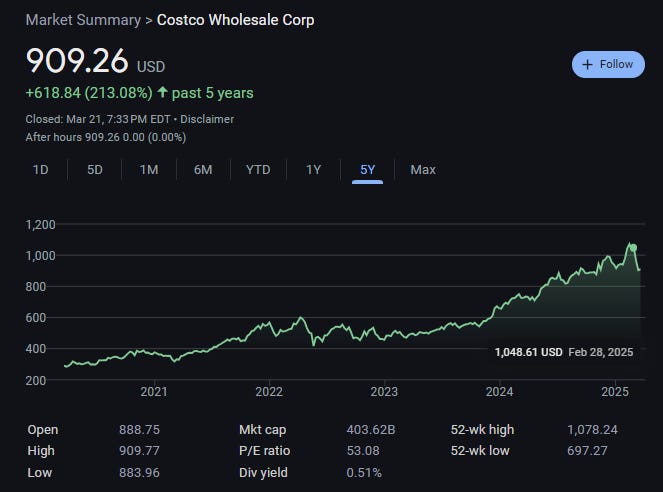
Seeking Alpha recently spoke about the company’s successes over the past few years, Its stock price has gone up 50% since last April. While this is great for those who invested before then, the writer notes this has resulted in Costco’s PE ration going up from 45x to 62x, despite modest sales and earnings growth.
They also point to how its valuation multiples have surpassed Walmart’s stock at its bubble peak in the late 1990s.
Tariffs are mentioned too. There’s a warning that Trump’s actions would hurt Costco’s operating profit margins by more than half. Costco has lower operating margins than Walmart already, meaning it would be more impacted by tariffs.
Once again, it seems Walmart is better positioned.
Nevertheless, other articles state how Costco has done well over the past few years despite inflation. One reason for this is its reliance on membership for revenue.
This is a decent counterargument. However, if times were already bad the past 5 years due to inflation, worse inflation may not mean Costco will get through a storm as easily.
Right now, I want to watch Walmart, Costco, and the Dollar Store together. Walmart stated at the end of last year that more wealthy Americans were shopping at their stores. The Dollar Store, however, has been bemoaning less foot traffic, and not because people can now afford to go elsewhere. If economic times get worse from Trump’s trade war, will we see Costco follow Walmart and see more upper-class customers? Perhaps we will see more middle-class folks step away from both of these and head to the Dollar Store.
Regardless, this discussion of Costco not only shows the company is deeply entwined within US-China relations but that a worsening trade war may hurt its business in both countries.