
不忘初心,方得始终

Over the past few years, I’ve been trying to reevaluate how I perceive the world, most notably by returning to first values. As I have done this, I’ve started to notice a pattern in how problems emerge. Everything begins with self-reflection. We all go about our days focused on goals. When these goals fail to be achieved, we become angry or sad. However, do we ever stop to really inquire as to why this is? Where do goals come about? To me, goals are planted due to values. We all perceive the world as it is and find it is in friction with how we want it to be. In its simplest form, we see this in hunger. Every day, I wake up and am driven by the goal of nourishment that stems from valuing energy. On a grander scale, I use the value of my life to seek out employment. Sometimes people value themselves to such an extent they want more than just a paycheck to pay the bills.
By now, you are maybe reading this asking what this has to do with the title of this article: BYD. I think self-reflection has everything to do with this. Confucius’s main teaching was that there was really no difference between person-to-person affairs and government affairs. All relationships are the same, regardless of what level they occur on. As a human, my interactions with others are judged based on the values they hold dear. I am better capable of forming good relationships when I align my values, and therefore my goals, with others.
It’s a simple equation, but when we expand it to national levels, it becomes very complicated.
I believe this is precisely the reason the US and China tend to be at one another’s throats all the time.
Without self-reflection, one cannot understand what they truly value. Without knowing what one values, one has no real goals. One does not know what they want. Without knowing what one wants, they lack proper communication. One could even argue a person’s self doesn’t even exist if their goals are already switching. Across a long period of time, a confused individual is merely a puppet being pulled by their social surroundings.
And unfortunately, all humans are bound by relationships to others, even if we do not know them on a personal level. This is why politicians and business people have a responsibility to themselves and others to know what they value. Their miscommunication doesn’t only hurt their own interests, it taints how those they are connected to are perceived.
Let me give you a few examples using BYD to illustrate this.
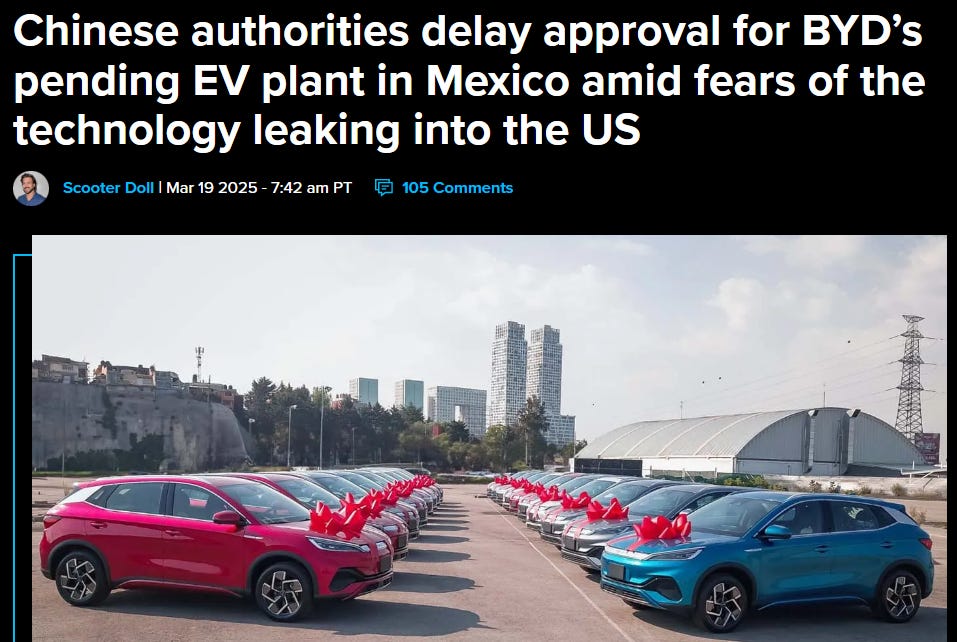
China’s government recently announced it didn’t want BYD setting up a factory in Mexico out of concerns the proximity to the US would lead to IP theft by American companies. English press was quick to jump to the irony of this given how much intellectual property is stolen every year by Chinese companies. BYD’s relationship with China hurts its branding, regardless of whether it has innovated without theft. Many non-Chinese will doubt BYD’s abilities simply due to how they perceive China.
Meanwhile, the US government has blacklisted BYD. As Trendforce exclaims:
The U.S. lawmakers is reportedly attempting to further drive the “decoupling” of the Pentagon’s supply chain from China. According to sources cited by Bloomberg, the U.S. Congress has prohibited the Pentagon from procuring batteries produced by six Chinese companies, including CATL and BYD.
As a one-off event, the logic used to explain this move makes sense. However, if we look at Trump bullying Taiwan for “stealing jobs” or appearing to bow to Putin over Ukraine, the argument begins to fall apart. Why does the US fear being too wrapped up with China and not other countries? Because the US views them as a bad actor. Why do we see them as a bad actor? Because they may invade Taiwan. If we no longer see Taiwan as a country to help, what’s the point of stalling China’s military? Is there any evidence the country wants to use its might elsewhere in the world? American companies are much more willing to share technology with Japan and Korea. Why would a China in a world where Taiwan isn’t important to us be different?
As CNN recently wrote:
For many on the self-governing island, the phrase “Ukraine today, Taiwan tomorrow” has increasingly resonated in recent weeks as they watch Trump upend longstanding US policy by playing up Kremlin rhetoric and warming to Moscow, while alienating traditional European allies and Kyiv. Taiwanese see parallels between their democracy and Ukraine, with both facing existential threats from aggressive, expansionist neighbors.
Washington earlier this month abruptly suspended military aid to Ukraine following a heated exchange between Trump, Vice President JD Vance and Ukrainian President Volodymyr Zelensky at the White House, just hours after the cheerful TSMC ceremony. It reinstated aid this week after Ukraine accepted a 30-day US-proposed ceasefire. The White House has also pressed Zelensky to sign a deal giving the US access to Kyiv’s untapped mineral riches.
Tammy Chao, a retiree, expressed deep concern to CNN about Taiwan’s security after TSMC’s announcement, likening Trump’s approach to his handling of Ukraine. She described him as a “dealer” who might eventually treat Taiwan as a bargaining chip.
I am not even mentioning all of the American conservatives who spend more time criticizing Zelenskyy instead of Putin.
Failure to have self-reflection and clear goals leads to confusion. If we say we value something one day and another the next, people will begin to wonder: what values have remained the same in all of these situations?
The answer could simply be “power”.
But in this case, if both the US and China consistently change all values but power, they are also undermining the very values they use to uphold nationalism. The US was founded on turning away from the “might is right” philosophy of the European Middle Ages. What does the Constitution or Declaration of Independence mean if the values found within them get ignored merely for the pursuit of power?
Chinese nationalism is just the same, founded on the preservation of 5,000 years of history and culture. Within this culture are the Confucian beliefs in respect, honesty, and many other values the country shares with the US. One could even compare the country’s actions to the words found in the socialist signs we see on many Chinese streets. What do all of these mean if they can be thrown out when they stop being useful to getting ahead?
If you were ever in a car and the driver kept changing their mind about where they wanted to go, how would you feel? One minute turning into a Mcdonalds, the next turning around after deciding cooking at home would be easier.